
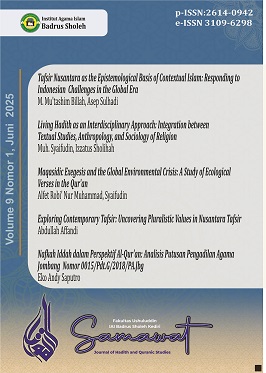
Exploring Contemporary Tafsir: Uncovering Pluralistic Values in Nusantara Tafsir
Abstract
This article explores the significant role of Nusantara Tafsir in promoting pluralistic values and fostering interfaith dialogue within Indonesia's diverse cultural landscape. Through the analysis of key works by prominent scholars such as Hamka and Quraish Shihab, the study highlights how these interpretations contextualize Quranic teachings to address contemporary social issues while emphasizing values such as tolerance, respect, and social justice. The case studies presented illustrate the unique characteristics of Nusantara Tafsir, including its integration of local wisdom and cultural practices, which enhance the relevance of Islamic teachings in the Indonesian context. Furthermore, the article discusses the contributions of Nusantara Tafsir to interfaith dialogue, emphasizing its role in promoting understanding and cooperation among different religious communities. By advocating for shared values and collaborative efforts, Nusantara Tafsir serves as a vital resource for building harmonious relationships in a pluralistic society. The findings underscore the importance of educational initiatives, interfaith dialogue programs, and grassroots movements in furthering the impact of Nusantara Tafsir on social harmony and understanding. This research contributes to the ongoing discourse on the relevance of Islamic teachings in addressing contemporary challenges and fostering a more inclusive society in Indonesia
References
Aziz, Thoriqul, Ahmad Z Abidin, and Muthmainnatun Nafiah. “Tafsir Nusantara Dan Isu-Isu Global: Studi Kasus Relevansi Pemikiran Hamka Tentang Keadilan Sosial, Kesetaraan Gender Dan Pluralisme.” Refleksi 19, no. 2 (2020): 217–36. https://doi.org/10.15408/ref.v19i2.16791.
Elius, M. “Interfaith Dialogue: An Islamic Framework.” J. Asiat. Soc. Bangladesh, Humi 68, no. 2 (2023): 193–206. https://doi.org/10.3329/jasbh.v68i2.70363.
Fadil, Muhammad R, and Suparwany Suparwany. “ULAMA TIGA SERANGKAI’S TAFSIR AL-QURÄNUL KARIM: Source, Method and Profiles of the Interpreters.” Journal of Contemporary Islam and Muslim Societies 6, no. 2 (2022). https://doi.org/10.30821/jcims.v6i2.12644.
Hamdani, Fakih. “Interfaith Dialogue in Islam.” Multi 1, no. 1 (2024): 37–44. https://doi.org/10.62207/c6ahas14.
Herlambang, Saifuddin. “Paradigm Shifts in the Interpretation of Heaven Illustration Among Indonesian Mufassir: A Comparative Analysis of as-Singkili, Hamka, and M. Quraish.” Jurnal Studi Ilmu-Ilmu Al-Qur an Dan Hadis 24, no. 1 (2023): 181–204. https://doi.org/10.14421/qh.v24i1.4454.
Hidayati, Husnul. “Metodologi Tafsir Kontekstual Al-Azhar Karya Buya Hamka.” El- Umdah 1, no. 1 (2018): 25–42. https://doi.org/10.20414/el-umdah.v1i1.407.
Husein, Fatimah. “Youth Expressions of Religiosity Through Dialogue in Indonesia.” International Journal of Interreligious and Intercultural Studies 2, no. 2 (2019): 1–17. https://doi.org/10.32795/ijiis.vol2.iss2.2019.447.
Irbah, Yumna. “Main the Principle of Inter-Religious Tolerance (A Comparative Study of the Interpretation of Surat Al Kafirun Between Hamka and Quraish Shihab.” Bir 1, no. 4 (2023): 21–34. https://doi.org/10.69526/bir.v1i4.2.
Ismail, Norbani B. “The Quranic Exegesis, Reformism, and Women in Twentieth Century Indonesia.” Studia Islamika 24, no. 3 (2017): 469–501. https://doi.org/10.15408/sdi.v24i3.5187.
Jannah, Miftahul, and Moh Jufriyadi Sholeh. “Kebebasan Beragama Dan Berbicara Dalam Bingkai Kajian Tafsir Nusantara.” Revelatia Jurnal Ilmu Al-Qur`an Dan Tafsir 2, no. 1 (2021). https://doi.org/https://doi.org/10.19105/revelatia.v2i1.4366.
Jonathan, Andreas, Paulus S Widjaja, and Fatimah Husein. “Fostering Religious Exclusivism and Political Pluralism in Indonesia Through Interfaith-Based Student Community.” Kne Social Sciences 3, no. 5 (2018): 53. https://doi.org/10.18502/kss.v3i5.2325.
Kusuma, Jamaludin H, and Sugeng H Susilo. “Intercultural and Religious Sensitivity Among Young Indonesian Interfaith Groups.” Religions 11, no. 1 (2020): 26. https://doi.org/10.3390/rel11010026.
Makhfud, Makhfud. “Urgensi Tafsir Maudhu`i (Kajian Metodologis).” Tribakti Jurnal Pemikiran Keislaman 27, no. 1 (2017). https://doi.org/10.33367/tribakti.v27i1.256.
Mubarok, Ahmad A, and Diaz G Rustam. “Islam Nusantara: Moderasi Islam Di Indonesia.” Journal of Islamic Studies and Humanities 3, no. 2 (2019): 153–68. https://doi.org/10.21580/jish.32.3160.
Mubarokah, Lailatin. “Theological-Based Dialogue in the Practice of Scriptural Reasoning at Young Interfaith Peacemaker Community.” El Harakah Jurnal Budaya Islam 25, no. 2 (2023): 346–67. https://doi.org/10.18860/eh.v25i2.23234.
Muhyiddin, Ahmad S. “The Interfaith Nyadran Tradition as a Manhaj of Islam Nusantara Da’wah in the Perspective of Multiculturalism.” Addin 17, no. 2 (2023): 201. https://doi.org/10.21043/addin.v17i2.19179.
Mujahidin, Anwar. “The Implication of Local Wisdom in Tafsir Al-Azhar on Moderate Islamic Thought by Hamka.” El Harakah Jurnal Budaya Islam 23, no. 2 (2021): 239–55. https://doi.org/10.18860/eh.v23i2.13414.
Mutalib, Marina M A, and Roslizawati M Ramly. “Potential Challenges of Interfaith Engagement: A Revisit to Al-Faruqi’s Contribution.” International Journal of Academic Research in Business and Social Sciences 13, no. 7 (2023). https://doi.org/10.6007/ijarbss/v13-i7/16710.
Mutaqin, Ayi Z, Badruzzaman M Yunus, and Bambang Qomaruzzaman. “Interfaith Marriage in the Perspectives of Indonesian Tafsir Ulama: Reviewing the Tafsir of Hamka, Quraish Shihab, and Musdah Mulia.” Hanifiya Jurnal Studi Agama-Agama 5, no. 2 (2022): 111–22. https://doi.org/10.15575/hanifiya.v5i2.18782.
Muwaffaq, Moh M. “Penafsiran Hamka Tentang Ayat Kemajemukan Dalam Tafsir Al-Azhar.” Mutawatir 9, no. 1 (2020): 109–24. https://doi.org/10.15642/mutawatir.2019.9.1.109-124.
Neufeldt, Reina C. “Interfaith Dialogue: Assessing Theories of Change.” Peace & Change 36, no. 3 (2011): 344–72. https://doi.org/10.1111/j.1468-0130.2011.00702.x.
Nirwana, Andri, Abd Wahid, Bukhori A Shomad, Sayed Akhyar, Hayati Hayati, Saifudin Saifudin, and Fauzan Nashrulloh. “Serving to Parents Perspective Azhar’s Quranic Interpretation.” Linguistics and Culture Review 6 (2022): 254–63. https://doi.org/10.21744/lingcure.v6ns5.2155.
Purwaningsih, Rahma F, and Doli Witro. “Islam Nusantara in Slogan Bhinneka Tunggal Ika: Al-Quran Perspective.” Cakrawala Jurnal Studi Islam 15, no. 1 (2020): 1–11. https://doi.org/10.31603/cakrawala.v15i1.3301.
Rani. “Epistemologi Penafsiran Nasaruddin Umar (Studi Buku Argumen Kesetaraan Gender Perspektif Al-Qur’An).” At-Tahfidz 3, no. 01 (2023): 88–104. https://doi.org/10.53649/at-tahfidz.v3i01.362.
Rofiqi, M A, and Mochamad Z Haq. “Islamic Approaches in Multicultural and Interfaith Dialogue.” Integritas Terbuka Peace and Interfaith Studies 1, no. 1 (2022): 47–58. https://doi.org/10.59029/int.v1i1.5.
Romziana, Luthviyah. “Pernikahan Lintas Agama; Kajian Muqarin Menurut Quraish Shihab Dalam Tafsir Al-Mishbah Dan Hamka Dalam Tafsir Al-Azhar.” Revelatia Jurnal Ilmu Al-Qur`an Dan Tafsir 2, no. 1 (2021): 1–30. https://doi.org/10.19105/revelatia.v2i1.4135.
Salam, Nor. “Nalar Inklusif Ayat-Ayat Kebebasan Beragama Dalam Tafsir Al-Mishbah.” Progresiva Jurnal Pemikiran Dan Pendidikan Islam 7, no. 2 (2019): 152–65. https://doi.org/10.22219/progresiva.v7i2.13979.
Setiawan, Ardhio, Saifudin Saifudin, Waston Waston, and Abdullah A Mahmud. “A Review of Tafsir Al-Misbah of Religious Tolerance in QS. Al-An’am Verse 108,” 2022. https://doi.org/10.2991/assehr.k.220708.007.
Setiawan, David E, and Kalis Stevanus. “Significance of Islam Nusantara Values in an Indonesian Multicultural Society.” Journal of Al-Tamaddun 18, no. 1 (2023): 203–14. https://doi.org/10.22452/jat.vol18no1.17.
Setiawan, Rahmadi A. “Corak Penafsiran Muhammad Quraish Shihab Dalam Tafsir Al-Mishbah.” Mushaf Journal Jurnal Ilmu Al Quran Dan Hadis 3, no. 1 (2023): 129–50. https://doi.org/10.54443/mushaf.v3i1.125.
Shamshudinova, G T, Meiramgul Altybassarova, Galiya Seifullina, Aigul Turlybekova, and Gulsara Dyussembekova. “State Model of Interconfessional Tolerance in Modern Multiethnic Societies.” Space and Culture India 7, no. 1 (2019). https://doi.org/10.20896/saci.v7i1.374.
Downloads
Published
How to Cite
Issue
Section
License
Copyright (c) 2025 IAI Badrus Sholeh Kediri

This work is licensed under a Creative Commons Attribution-NonCommercial-ShareAlike 4.0 International License.
